Starting a Native Garden from Scratch: A Practical Guide for Australian Gardeners
That bare patch of earth out the back can feel intimidating. Maybe it’s a new build with compacted clay, maybe it’s an old lawn you’ve finally decided to rip up, or maybe it’s just a rectangle of weeds you’ve been avoiding for two summers. We’ve stood on that exact spot, scratching our heads, wondering where to begin. This is the no-nonsense, first-person walkthrough we wish we’d had: how we plan, plant and grow a thriving native garden from nothing, using Australian native plants that actually want to live here.
Why We Plant Australian Native Plants
We didn’t start planting natives purely out of patriotism. We did it because the results speak for themselves. Australian native plants evolved on this continent over millions of years, through droughts, fires and nutrient-poor soils. When you plant them, you’re not fighting the environment — you’re working with it. And the payoff isn’t just a garden that survives. It’s one that hums, chirps and buzzes.
Water-Wise and Drought-Tolerant by Design
Most of us have lived through at least one serious water restriction. Natives handle it. Species like grevillea, banksia and westringia have adapted to low rainfall and hot summers, often thriving on less water than a single thirsty exotic hedge. Once established, many will survive on rainfall alone in southern Australia. That’s not just good for the bill — it’s good for the conscience.
Habitat for Local Wildlife
A native garden is a tiny piece of restored country. Plant a grevillea and the honeyeaters will find it within weeks. Add a kangaroo paw and you’ll see native bees and butterflies working the flowers. We’ve watched blue-tongue lizards shelter under westringia and wattlebirds squabble over banksia cones. You can’t get that from a lilly pilly hedge alone. Local birds, bees and butterflies need local plants — it’s that simple.
Low Maintenance, High Reward
People assume natives are fussy. In our experience, the opposite is true. Give them the right spot, the right soil and a bit of water in the first year, and they largely look after themselves. No weekly spraying, no constant feeding, no replacing things every season. We spend more time sitting in the garden than working in it these days.
Planning Your Native Garden: Site, Soil and Sun
Before we buy a single plant, we walk the block. Properly. Not just a glance from the back door — we mean standing out there at different times of day, in different weather, and actually reading what the site is telling us. Matching plants to your local rainfall and soil type is the difference between a garden that thrives and one that limps along.
Reading Your Site: Sun, Wind and Drainage
We note where the sun lands in winter versus summer, where the hot westerly wind rips through, and where water pools after rain. A spot that bakes from noon onwards suits westringia and most grevilleas. A damp corner near the downpipe might suit a fern or a lomandra. Get this wrong and no amount of care will fix it.
Testing and Improving Australian Soils
Most of our soils are old, leached and low in phosphorus — which is exactly what natives are built for. But pH still matters. We grab a soil pH test kit from our local nursery or Bunnings (they’re cheap and take ten minutes), and check whether we’re dealing with acid, neutral or alkaline ground. If it’s heavy clay, we break it up with gypsum and compost before planting. If it’s pure sand, we add aged bark and clay to hold moisture. Local nurseries and Bunnings often stock native plant varieties and soil testing kits, so a single trip covers both.
Designing with Layers and Structure
We think in three layers: groundcovers, mid-shrubs and a canopy. Groundcover grevilleas and native grasses fill the base. Westringia, correa and kangaroo paw form the middle. A banksia or a tree-form grevillea gives height and structure. Layers look natural, shelter wildlife and mean fewer weeds get a foothold.
Choosing the Best Australian Native Plants for Your Patch
This is where opinion gets strong. We have our favourites, and we’re not shy about them. But the honest answer is that the best plant is the one suited to your specific spot.
Grevillea: The Backbone of Our Native Garden
If we had to pick one genus, it’s grevillea. It’s a diverse genus with groundcover, shrub and tree forms suited to many Australian gardens — so there’s one for almost every patch, from a sprawling ‘Royal Mantle’ to a tall ‘Moonlight’ or a slender ‘Robyn Gordon’. They flower for months, feed the birds and tolerate poor soil. Grevillea is the backbone of our native garden, full stop.
Bush Tucker Plants Worth Growing
We grow edible natives right alongside the ornamentals. Lemon myrtle makes a stunning small tree with citrus-scented leaves for teas and baking. Finger lime is a prickly but rewarding shrub with pearl-like citrus pulp. Wattleseed comes from acacia and adds a roasted, coffee-like flavour to baking. All three grow well in home gardens and give you something to actually harvest.
Drought-Tolerant Heroes for Harsh Spots
For the forgotten corners — the hot, dry, windy spots nothing else survives — we reach for these:
- Westringia (native rosemary): tough, tidy and covered in small mauve flowers.
- Banksia: slow-growing but spectacular, and a magnet for nectar-feeding birds.
- Kangaroo paw: brilliant in full sun, though it wants sharp drainage.
- Lomandra: an unkillable strappy grass for borders and slopes.
- Acacia (wattle): fast-growing, nitrogen-fixing and brilliant for screening.
Planting, Watering and Establishing Your Natives
The first twelve months decide everything. Get them right and your natives will settle in for decades. Get them wrong and you’ll be replacing plants every season.
When and How to Plant
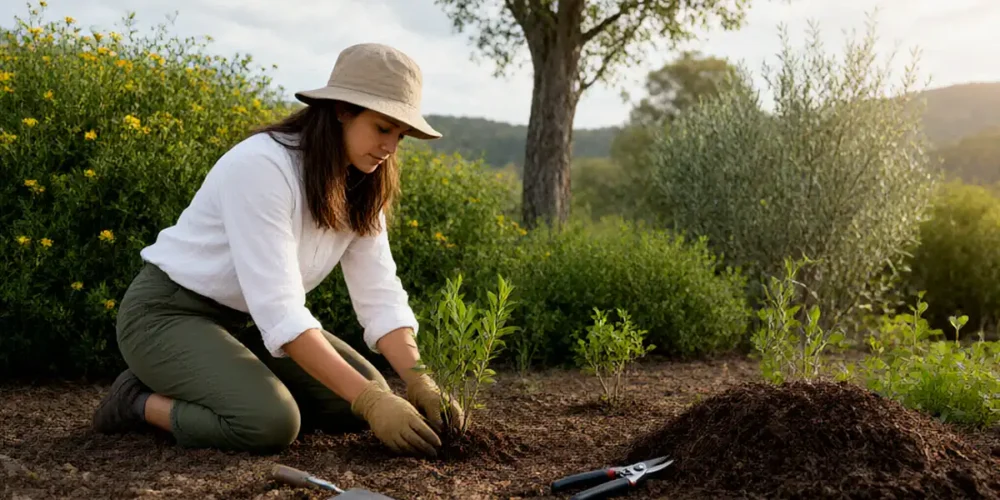
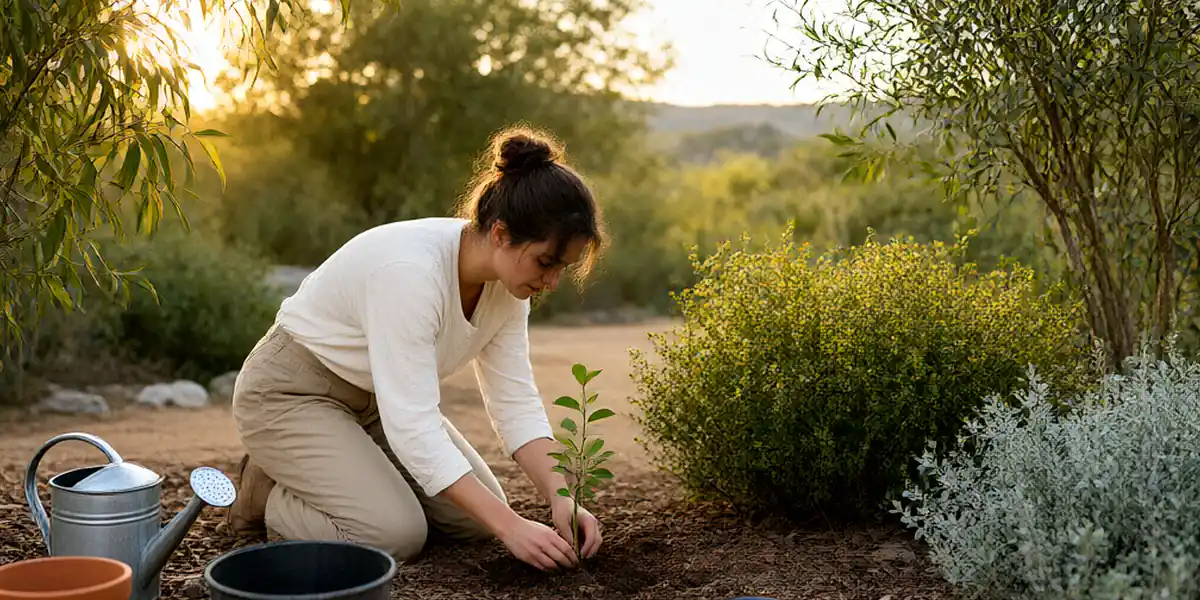
Autumn and early spring are generally the best times to plant natives in southern Australia. Autumn is our pick — the soil is still warm, the rains are coming and roots get a head start before summer. We dig a hole twice as wide as the pot but no deeper, tease out the roots, and backfill with the original soil rather than rich compost. Natives don’t want a luxury bed; they want a familiar one.
Watering Wisely While Roots Establish
Deep watering twice a week for the first few months beats a daily sprinkle. We water in the morning, soak the root zone and let it dry slightly between drinks. After the first summer, we taper off. By year two, most of our plants are on rainfall alone.
Mulching and Weed Control
We mulch with coarse aged bark, kept a few centimetres clear of the trunk to avoid collar rot. Mulch holds moisture, suppresses weeds and keeps soil temperatures down. We hand-pull weeds rather than spray, especially near young plants. One important note: many Australian native plants are adapted to low-phosphorus soils and can be damaged by standard fertilisers. If you feed at all, use a low-phosphorus native fertiliser, and only lightly in spring.
Ongoing Care and Our Favourite Bush Tucker Harvests
Once established, a native garden is more about gentle shaping than heavy labour. We spend our time pruning, watching for problems and harvesting the good stuff.
Pruning for Shape and Flowers
We tip-prune grevilleas and westringia after flowering to keep them dense and stop them going leggy. Never cut back into old bare wood on a grevillea — it rarely reshoots. A light trim a couple of times a year is all most natives need.
Pests and Problems We Actually See
Honestly, not much. The main issues are root rot in poorly drained spots, scale on stressed plants and the occasional caterpillar on kangaroo paw. Healthy, well-sited natives shrug most things off. If we see a problem, we check the soil and water first before reaching for anything.
Harvesting Bush Tucker at Home
Bush tucker plants such as lemon myrtle, finger lime and wattleseed can be grown in home gardens, and harvesting them is one of the great joys of a native patch. We pick lemon myrtle leaves fresh for tea, squeeze finger lime pearls over seafood and grind roasted wattle seeds into flour. Bush tucker is best harvested sustainably — take only what you need, leave plenty for the birds, and never strip a plant bare.
FAQ
What is the best time to plant Australian native plants?
In southern Australia, autumn and early spring are generally the best times to plant natives. Autumn is ideal because the soil is still warm and the winter rains help roots establish before the heat of summer.
Do Australian native plants need fertiliser?
Mostly no. Many Australian native plants are adapted to low-phosphorus soils and can be damaged by standard fertilisers. If you do feed, use a low-phosphorus native fertiliser in spring and only lightly.
Can I grow bush tucker plants in a small backyard?
Absolutely. Lemon myrtle, finger lime and wattleseed all grow well in home gardens, including smaller yards. Finger lime works in a large pot, and lemon myrtle can be kept pruned to a manageable size.
Where can I buy native plants and soil testing kits?
Local nurseries and Bunnings often stock native plant varieties and soil testing kits. Independent native nurseries usually have the widest range, but Bunnings is a solid starting point for common species.
Which grevillea should I choose for my garden?
It depends on your space. Grevillea is a diverse genus with groundcover, shrub and tree forms suited to many Australian gardens. Choose a groundcover like ‘Royal Mantle’ for slopes, a shrub like ‘Robyn Gordon’ for bird-attracting colour, or a taller form like ‘Moonlight’ for screening.
Start small. Plant a handful of natives, watch how they respond to your site, and let the garden teach you. Over a few seasons you’ll see honeyeaters return, the water bill drop and a patch of bare earth turn into something alive. That’s the long-term reward of a native garden — one that supports Australian wildlife and gives back far more than it asks for.